


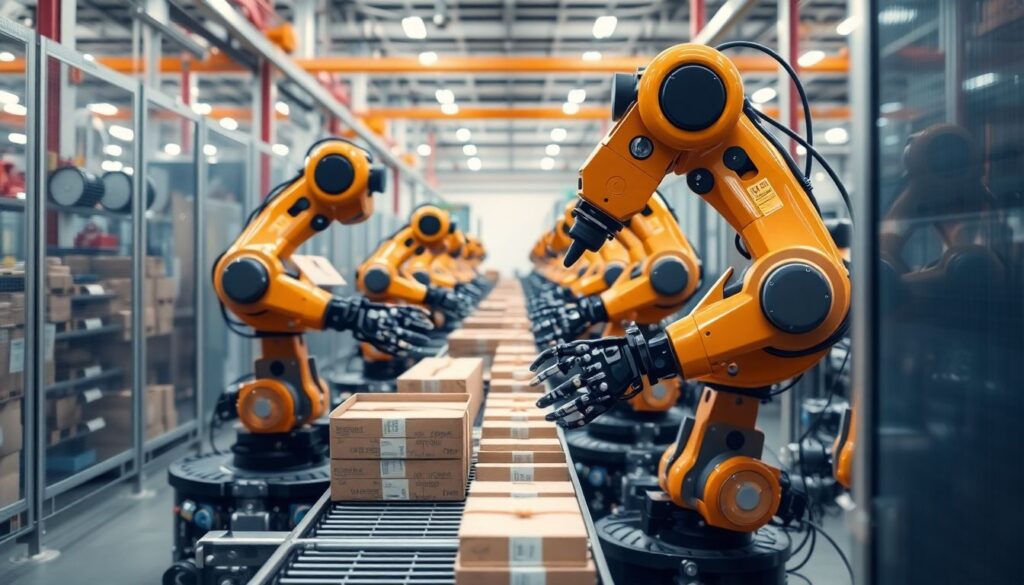
In the rapidly evolving landscape of manufacturing and production, the integration of automated guided vehicles (AGVs) and autonomous mobile robots (AMRs) is revolutionizing material handling processes. These advanced technologies are not only enhancing efficiency but also transforming traditional workflows, leading to significant improvements in productivity and operational effectiveness. As industries strive to meet increasing demands and maintain competitive edges, the adoption of AGVs and AMRs is becoming a pivotal strategy. This article delves into the profound impact of these technologies on material handling, exploring their benefits, the role of advanced robotics, and the reshaping of conventional manufacturing practices.
Benefits of Automation in Material Handling
Automation in material handling offers a multitude of advantages that are crucial for modern production environments. One of the primary benefits is the significant increase in efficiency. Automated systems can operate continuously without the need for breaks, thereby maximizing throughput and reducing downtime. This continuous operation is particularly beneficial in industries with high-volume production requirements.
Moreover, automation reduces the likelihood of human error, which can lead to costly mistakes and delays. By utilizing AGVs and AMRs, companies can ensure that materials are transported accurately and consistently, enhancing overall reliability. These systems are equipped with sophisticated sensors and navigation technologies that allow them to maneuver safely and efficiently within complex environments.
Another key advantage is the flexibility that automation provides. AGVs and AMRs can be easily reprogrammed or reconfigured to accommodate changes in production layouts or processes. This adaptability is essential in today’s dynamic manufacturing landscape, where companies must be able to respond quickly to market demands and technological advancements.
For more information on AGV and AMR systems, visit https://etisoft.eu/pc/agv-amr-systems/.
The Role of Advanced Robotics in Enhancing Productivity
Advanced robotics play a crucial role in enhancing productivity within production environments. By integrating AGVs and AMRs, companies can streamline their operations and optimize resource utilization. These robots are designed to perform repetitive and labor-intensive tasks, freeing up human workers to focus on more complex and value-added activities.
AGVs and AMRs are equipped with cutting-edge technologies such as machine learning and artificial intelligence, enabling them to learn from their environments and improve their performance over time. This capability allows them to adapt to changing conditions and optimize their routes and tasks for maximum efficiency.
Furthermore, the use of vision systems enhances the capabilities of these robots, allowing them to identify and interact with objects in their environment with precision. This technology is particularly useful in quality control and inspection processes, where accuracy is paramount. For more details on vision systems, visit https://etisoft.eu/pc/vision-systems/.
Reshaping Traditional Manufacturing Practices
The integration of AGVs and AMRs is reshaping traditional manufacturing practices by introducing new levels of automation and efficiency. These technologies are enabling companies to transition from manual, labor-intensive processes to automated, streamlined operations. This shift not only improves productivity but also enhances safety by reducing the need for human workers to perform hazardous tasks.
In addition, the use of AGVs and AMRs supports the implementation of just-in-time (JIT) manufacturing practices. By ensuring that materials are delivered precisely when needed, these systems help to minimize inventory levels and reduce waste. This approach aligns with the principles of lean manufacturing, which aim to maximize value while minimizing waste.
As companies continue to adopt AGVs and AMRs, they are also exploring new business models and strategies. For example, some manufacturers are leveraging these technologies to offer customized products and services, thereby enhancing their competitive advantage. The ability to quickly and efficiently adapt to customer demands is becoming increasingly important in today’s fast-paced market.
In conclusion, the integration of automated guided vehicles and autonomous mobile robots is transforming material handling processes in production environments. By enhancing efficiency, productivity, and flexibility, these technologies are reshaping traditional manufacturing practices and paving the way for a more automated and efficient future.