



In the modern sports landscape, data reigns supreme. Long gone are the days when raw talent and gut instincts were the only tools for players, coaches, and analysts. Today, player stats have emerged as the cornerstone of athletic performance evaluation, team strategy formulation, and fan engagement. These statistics go far beyond traditional scorekeeping, diving deep into performance metrics that were unimaginable a decade ago.
In this comprehensive article, we explore the multifaceted universe of player stats—from traditional box scores to advanced analytics—uncovering how they shape the present and future of sports.
Why Player Stats Matter More Than Ever
Player stats are no longer just filler information on a scorecard or trading card. They have become vital indicators of skill, potential, and contribution. Every pass completed, every sprint executed, and every decision made during a game can be captured, analyzed, and converted into meaningful metrics.
What’s driving the explosion of player stats?
- Technology: Wearable sensors, AI video analysis, and GPS tracking have revolutionized the way data is collected.
- Analytics Culture: Inspired by sabermetrics in baseball, every major sport has adopted analytical models.
- Business & Contracts: Stats are now essential in determining player valuation, endorsements, and salary negotiations.
- Fan Engagement: Fantasy leagues and sports betting have driven the demand for deeper insights into player performance.
The Evolution of Player Stats: From Box Scores to Biometric Intelligence
The journey of player stats has been nothing short of transformative.
1. The Era of Traditional Metrics
In the early days, player stats were largely limited to basic data points: points scored, goals made, assists, rebounds, tackles, or saves. These stats painted a basic portrait of a player’s involvement in a game but offered little context.
2. The Age of Advanced Analytics
As computing power increased, so did our ability to process vast amounts of data. Advanced stats emerged—metrics like PER (Player Efficiency Rating), WAR (Wins Above Replacement), and xG (Expected Goals). These provided a more nuanced view of player performance by factoring in context, opposition strength, and situational dynamics.
3. The Modern Paradigm: Real-Time and Predictive
Now, player stats are generated in real time, with wearable tech monitoring biometric data such as heart rate, acceleration, and fatigue. Machine learning models can even predict a player’s likelihood of injury or future performance, shifting the focus from descriptive to predictive analytics.
Beyond the Numbers: What Player Stats Reveal
While raw numbers are informative, the true value of player stats lies in interpretation.
Performance Trends
Tracking performance across games or seasons reveals patterns that help in decision-making. A striker’s goal drought, for instance, might be better understood through underlying metrics like shots on target or xG.
Tactical Insights
Coaches use player stats to devise strategies. Knowing that a midfielder excels in high-press situations or that a defender has a high interception rate can drastically alter a game plan.
Scouting & Recruitment
Stats play a pivotal role in scouting. With global databases of player stats, clubs and agents can discover talent across leagues and continents, leveling the playing field for smaller teams.
Fan Engagement & Fantasy Sports
From fantasy football to sports betting apps, fans rely heavily on detailed player stats to make decisions, often with financial stakes involved. This has created an entire ecosystem where accurate and up-to-date stats are as valuable as the game itself.
Sport-Specific Breakdowns: How Player Stats Differ Across Disciplines
While the core idea of tracking performance is universal, different sports emphasize different types of player stats.
Football (Soccer)
- Key Stats: Goals, assists, key passes, xG, xA, dribbles, interceptions.
- Emerging Metrics: Pressures per 90 minutes, progressive carries, goal prevention index (GPI).
- Why It Matters: Soccer’s low-scoring nature makes context-rich stats crucial for understanding influence.
Basketball
- Key Stats: Points, rebounds, assists, blocks, steals.
- Advanced Metrics: PER, true shooting percentage (TS%), usage rate, box plus-minus (BPM).
- Trend: NBA teams rely heavily on player stats to optimize rotations and rest patterns.
American Football
- Key Stats: Passing yards, rushing yards, tackles, interceptions, QB rating.
- Next-Gen Stats: Time to throw, average separation, yards after catch (YAC).
- Fun Fact: NFL’s partnership with AWS has turned player stats into 3D spatial models for simulation.
Baseball
- Key Stats: Batting average, home runs, ERA, strikeouts.
- Sabermetrics: WAR, OBP, WHIP, exit velocity.
- Why It’s Unique: Baseball was the first to widely adopt advanced stats, changing how players are valued.
Esports
- Key Stats: K/D ratio, assists, APM (actions per minute), objective control.
- New Frontier: Cognitive performance metrics, such as reaction time and strategic decision-making under pressure.
- Insight: Esports might be the most data-rich sport due to digital-native environments.

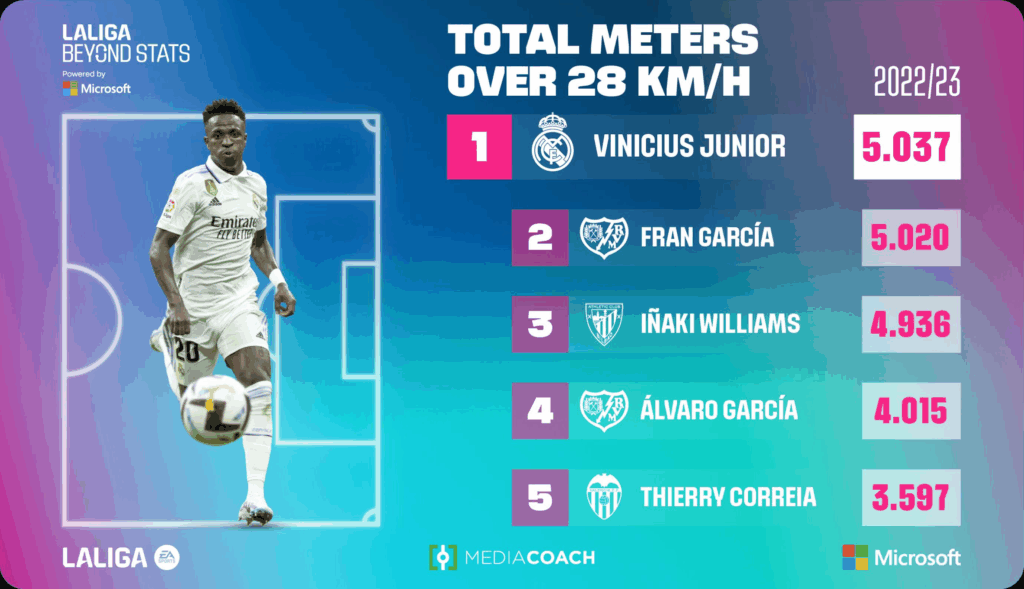
Hidden Metrics: The Underappreciated Side of Player Stats
Not all player stats are obvious. Some are “hidden” yet profoundly influential.
- Clutch Index: Measures performance under pressure.
- Recovery Speed: Time taken to regain stamina or positioning.
- Involvement Rate: Percentage of team actions a player is part of.
- Player Influence Graphs: Visualizes the network of passes or interactions.
These stats might not feature on highlight reels, but they win games and inform billion-dollar decisions.
The Business of Player Stats
Player stats aren’t just for fans and coaches—they drive an entire industry.
Media & Broadcasting
Live player stats overlays are now standard in broadcasts. Commentary is increasingly data-informed, and post-match analyses are structured around stats dashboards.
Fantasy Sports & Betting
Daily Fantasy Sports (DFS) platforms like DraftKings or FanDuel depend entirely on real-time and predictive stats. Bookmakers also use player stats to set odds and calculate risks.
Sponsorship & Branding
Brands analyze player stats to identify athletes who align with their marketing goals. A high-engagement player with strong metrics is far more valuable than one with inconsistent stats.
Ethical Implications: Ownership and Privacy
As stats delve deeper into biometric and cognitive data, new ethical questions arise:
- Who owns the data—players, teams, or leagues?
- Can player stats be used without consent?
- How secure is the transmission and storage of such sensitive data?
Organizations like FIFPro and the NFL Players Association are pushing for legislation to protect players’ rights in the age of datafication.
The Future of Player Stats: AI, AR, and Beyond
The horizon is limitless when it comes to the future of player stats.
- Artificial Intelligence: AI models are beginning to make real-time coaching suggestions based on in-game stats.
- Augmented Reality: Fans in stadiums may soon view live stats overlays via AR glasses.
- Digital Twins: A player’s virtual model, constantly updated with real-world data, can simulate scenarios and training modules.
Soon, we may have fully immersive experiences where every move of a player is tracked, visualized, and analyzed in ways we can barely imagine today.
Final Thoughts: Embracing the Stats Era
Whether you’re a coach trying to gain a tactical edge, a fan building a fantasy team, or a sports executive planning a multi-million-dollar trade, player stats are the foundation of smart decision-making. The beauty of modern sports lies not just in the spectacle but in the science behind it—and player stats are the language of that science.
As we continue to embrace innovation, one truth becomes evident: numbers don’t lie. But more importantly, in the world of sports, numbers tell stories—and those stories are richer, smarter, and more thrilling than ever before.
Read Also:- How 3D Visualization Enhances Communication and Collaboration in Design