What if Gatsby’s life was a roller coaster? Imagine stepping into a carnival where every twist, loop, and plunge perfectly mirrors the highs and lows of Jay Gatsby’s existence. This isn’t just a whimsical analogy—it’s a fresh lens to explore the grandeur and tragedy of The Great Gatsby. Buckle up as we dissect the emotional peaks and devastating descents of Gatsby’s pursuit of the American Dream.
The Roller Coaster Begins: Gatsby’s Ascent From Nothing
When we think about a roller coaster, the first thing that comes to mind is the slow, thrilling climb. It’s full of anticipation, where every click of the track builds suspense. This is the perfect metaphor for Gatsby’s rise.
Born James Gatz to poor farmers, he was a boy with big dreams. The climb of the coaster represents his transformation into Jay Gatsby—the enigmatic millionaire. His life starts with small steps: meeting Dan Cody, reinventing his identity, and envisioning a future far greater than the one he was born into.
This phase feels exhilarating yet nerve-wracking. Just like when a coaster ascends to its peak, Gatsby’s ambition feels limitless. He throws lavish parties, gathers wealth, and surrounds himself with glamour. The world watches in awe. But as every roller coaster rider knows, what goes up must come down.
The First Drop: Chasing the Illusion of Daisy
The first major plunge in Gatsby’s roller coaster life comes with his pursuit of Daisy Buchanan. To Gatsby, Daisy isn’t just a woman; she’s the embodiment of all he’s worked for. She’s the green light at the end of his dock, a symbol of success, love, and validation.
But like a sudden drop on a roller coaster, reality hits hard. Daisy is married. She’s part of a world that is careless, cold, and impenetrable. Gatsby’s dream starts showing cracks. The exhilarating high of seeing Daisy again turns into stomach-churning uncertainty as he realizes the depth of her entanglement with Tom Buchanan.
This drop isn’t just emotional—it’s existential. Gatsby begins to question if the dream he’s been chasing all these years was ever real.
The Loop-the-Loops: Lies, Secrets, and High Society
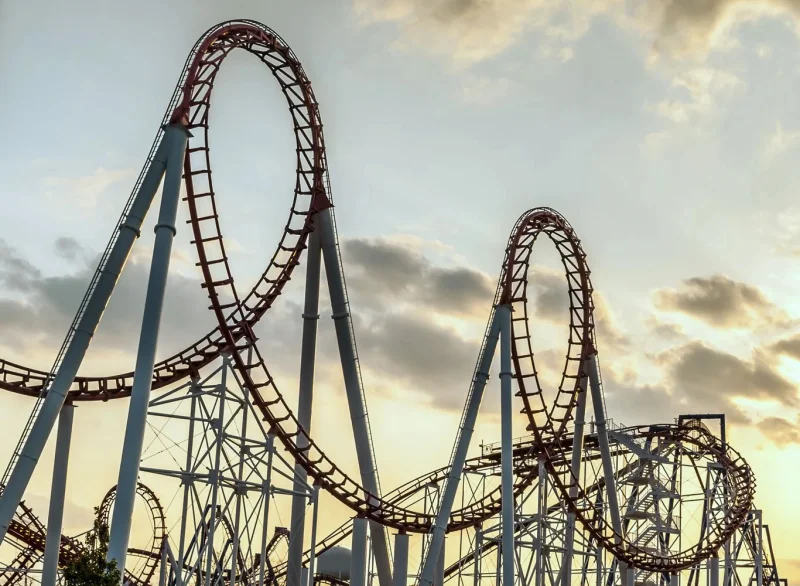
Imagine a roller coaster whipping you through loops—disorienting, thrilling, and terrifying all at once. Gatsby’s entanglement in West Egg’s elite social circle mirrors this. His mansion, parties, and mysterious past all form a dizzying loop of speculation and gossip.
Each loop represents a lie or secret:
- His bootlegging operations
- The fabrications about his aristocratic origins
- The false sense of belonging in the world of old money
These loops feel endless and chaotic. Gatsby keeps spinning, hoping the momentum will eventually straighten out his path to Daisy. But each turn only pulls him deeper into a world that sees him as an outsider.
The Sudden Free Fall: Myrtle’s Death
No roller coaster metaphor would be complete without a stomach-dropping free fall. For Gatsby, this comes when Myrtle Wilson dies. Though he wasn’t driving, Gatsby takes the blame to protect Daisy. This moment marks the beginning of his final descent.
The weightless feeling of a free fall matches Gatsby’s loss of control. His carefully constructed world begins to crumble: Daisy withdraws, Tom seizes the narrative, and the people who once flocked to his parties disappear overnight.
This isn’t just a drop—it’s a plunge into a pit from which Gatsby will never recover.
The Brutal End: The Final Stop of the Ride
If you’ve ever been on an intense roller coaster, you know the screeching halt at the end is almost as jarring as the ride itself. Gatsby’s death is that abrupt stop. Alone in his pool, he’s shot by George Wilson in a tragic case of mistaken revenge.
All the loops, climbs, and drops culminate in a heartbreaking silence. The crowds are gone. The music has stopped. And Gatsby, the man who built his life on relentless hope, lies still—his dream unfulfilled.
This finality leaves us, the riders, with an eerie sense of loss. The thrill of the ride fades, replaced by a sobering realization: Gatsby was never in control.
Why Gatsby’s Roller Coaster Matters Today
Why does it resonate so deeply when we say, “if Gatsby’s life was a roller coaster”? Because roller coasters are built to thrill and terrify—just like the pursuit of the American Dream.
Gatsby’s journey is still relevant in today’s world:
- The obsession with wealth and status
- The idealization of relationships
- The relentless pursuit of an unattainable dream
We ride our own roller coasters every day. Some of us are still climbing; others are bracing for the next drop. Gatsby’s story reminds us that chasing illusions comes with consequences.
What We Can Learn From Gatsby’s Ride
Though tragic, Gatsby’s roller coaster life teaches timeless lessons:
- Hope is powerful but dangerous: Gatsby’s unshakable optimism was both his greatest strength and his undoing.
- Dreams must be grounded in reality: A roller coaster is thrilling because it ends safely. Gatsby’s dream lacked that safe exit.
- True belonging matters more than appearances: Despite his wealth, Gatsby never truly belonged to Daisy’s world.
When we ask, if Gatsby’s life was a roller coaster, what kind of ride was it? The answer is clear: a beautifully designed but fatally flawed one.
Closing Thoughts: Would You Ride Gatsby’s Roller Coaster?
So, if you found yourself at the entrance to a theme park and saw a sign saying “If Gatsby’s Life Was a Roller Coaster,” would you get in line?
It promises breathtaking views, moments of joy, and a heart-stopping finale. But be warned—it’s a one-way trip, with no second chances and no brakes.
This metaphor isn’t just literary fun—it’s a mirror. Gatsby’s ride is our own: daring us to ask if the dreams we chase are worth the loops and free falls.
Read Also:- Pyntekvister